



Scheduled HTTP jobs that run like clockwork.
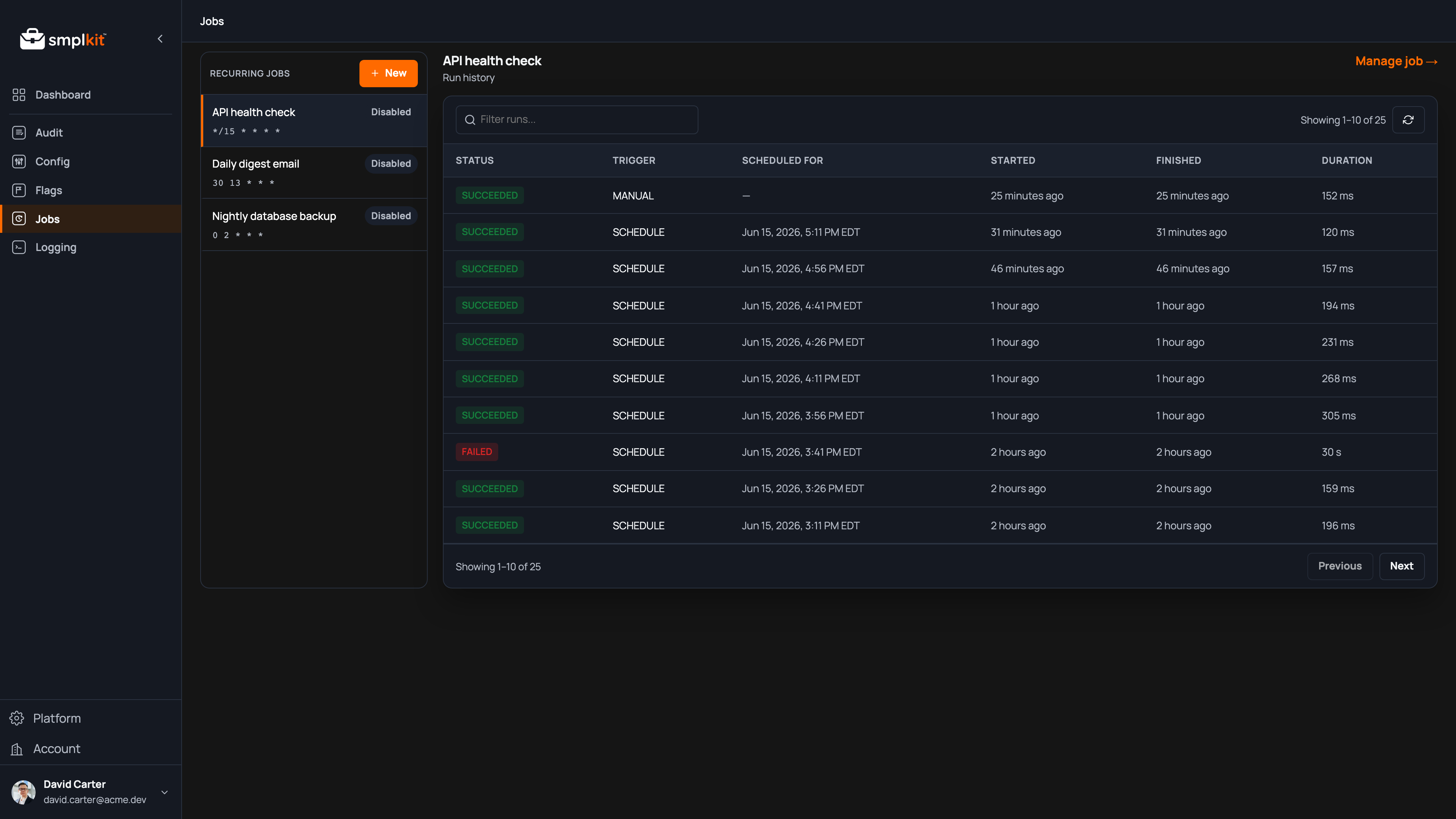
Schedule an HTTP request once at a future time, or on a recurring cron schedule. Smpl Jobs runs it for you and captures every request, response, and outcome — so you can see exactly what happened, cancel a run, or re-run it on demand.
01
Cron and one-off schedules
Schedule a request once at a future time, or on a recurring cron schedule. Change or cancel it anytime from the console or the API.
02
Timeouts and full control
A per-run timeout keeps a slow endpoint from hanging your schedule, with the cap rising on higher plans. Cancel a run in flight, or re-run any past execution on demand.
03
Full run history
Every run captures its request, response, timing, and outcome — so you can see exactly what happened, debug a failure, and re-run on demand.
Weighing your options? Read our honest, fact-checked comparison: The Best Cron Job Services for 2026 →
How Smpl Jobs stacks up
Smpl Jobs is a scheduler that posts an HTTP request — deliberately not a workflow engine. Against the cloud schedulers it matches their developer surface — SDKs, a CLI, and a Terraform provider — while adding what a scheduler bolted onto a hyperscaler doesn't give you: per-environment schedules and configuration, a run history you can actually query, change history and point-in-time restore on your job definitions, and integration with the rest of the smplkit platform. Against a free hosted scheduler, the win is a managed, production-grade control plane that scales with you.
✓ means the capability is supported. A blank cell means it isn't a product capability. Some rows show a value — a count, a duration, or a price — instead of a checkmark. A superscript marks a footnote with a caveat worth reading.
| AWS EventBridge Scheduler | Google Cloud Scheduler | cron-job.org | Smpl Jobs™ | |
|---|---|---|---|---|
| Recurring cron schedules | ✓ | ✓ | ✓ | ✓ |
| Timezone handling | ✓ | ✓ | ✓ | ✓ |
| Post to any public URL | ✓1 | ✓ | ✓ | ✓ |
| Configurable retry policies | ✓ | ✓ | ✓ | |
| Configurable timeouts | ✓ | ✓ | ✓ | |
| SDKs, CLI & Terraform provider | ✓ | ✓ | ✓ | |
| One-off jobs | ✓ | ✓ | ||
| Full response capture | ✓ | ✓ | ||
| Webhook notifications | ✓ | ✓ | ||
| Per-environment schedules & configuration | ✓ | |||
| Configurable success criteria | ✓ | |||
| Change history | ✓ | |||
| Point-in-time restore | ✓ | |||
| Run history retention | None | None2 | Last 50 runs | Up to 10 years |
| — Pricing — | ||||
| Included runs / month | 14M free, then metered | Unlimited (per-job pricing) | Unlimited | 3K / 100K / 1M / 10M |
| Monthly price | $1 / M invocations | $0.10 / job | Free | Free / $19 / $49 / $149 |
- ↩ EventBridge Scheduler reaches an external URL through EventBridge API Destinations: a separate Connection and API Destination you configure, not a URL field on the schedule itself.
- ↩ Cloud Scheduler writes execution results to Cloud Logging (general-purpose logs), not a dedicated, queryable run history.